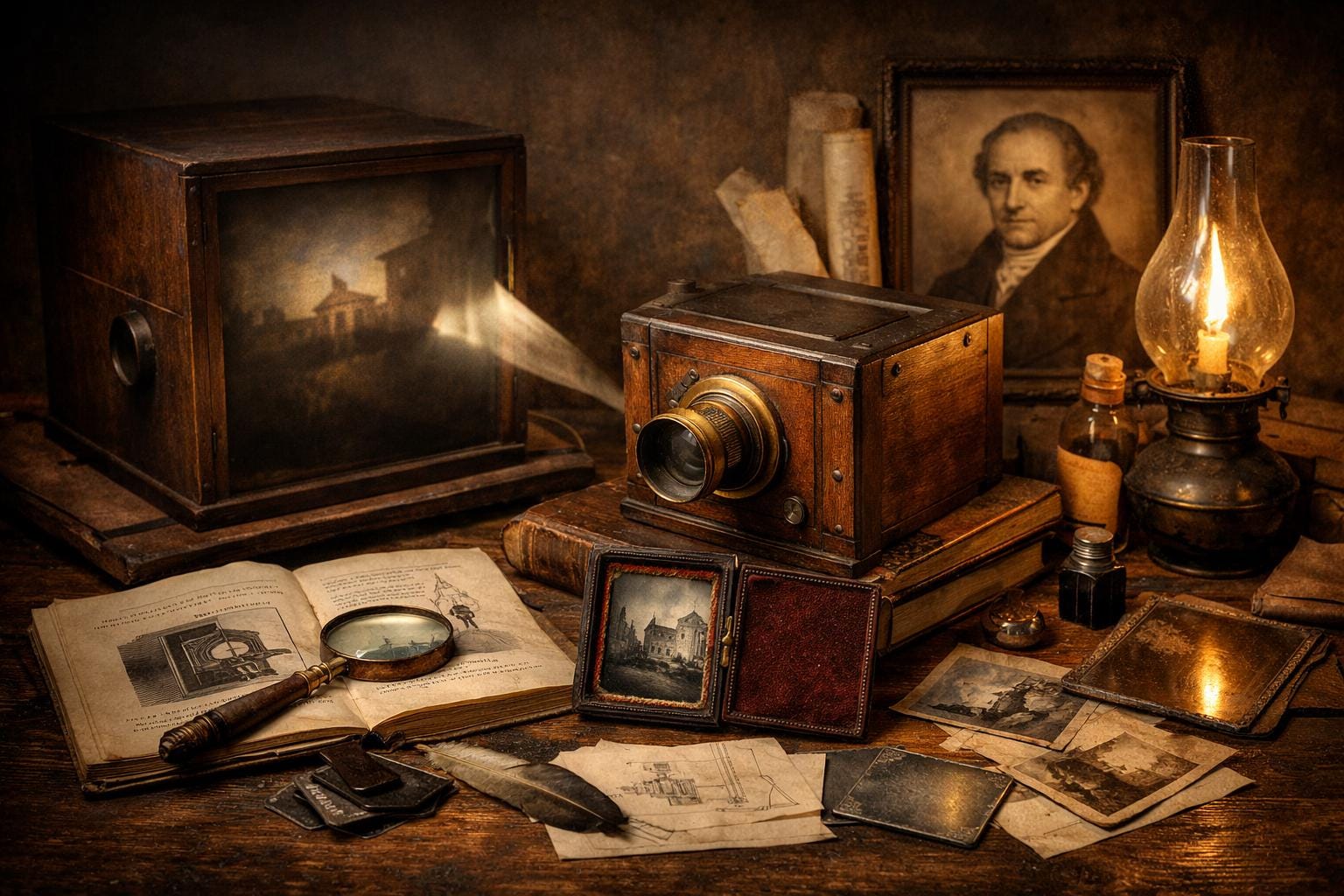
Where Photography Began Long before digital sensors, film rolls, or even photographs themselves, the idea of capturing an image was already taking shape. The story of the first camera isn’t about a single device it’s about centuries of curiosity, science, and experimentation that laid the foundation for photography as we know it today. The Camera Before Photography: Camera Obscura The earliest form of a camera was the camera obscura, a Latin term meaning “dark room.” This device dates back to ancient times and was described by scholars as early as the 5th century BCE. A camera obscura is a darkened room or box with a small hole on one side. Light passes through the hole and projects an inverted image of the outside scene onto the opposite wall or surface. While it couldn’t record images, it proved a revolutionary concept: light could create pictures. Artists later used portable camera obscuras to help with drawing accurate perspective, making it a crucial step toward modern photography. The First Photograph Ever Taken The leap from projecting an image to permanently capturing one happened in the early 19th century. In 1826, Nicéphore Niépce created the world’s first permanent photograph using a camera obscura fitted with a light-sensitive plate. The image, View from the Window at Le Gras, required an exposure time of several hours. This marked the birth of photography but the camera itself was still evolving. The First Practical Camera Niépce later partnered with Louis Daguerre, who went on to develop the daguerreotype process in 1839. This innovation led to the first practical photographic cameras wooden boxes equipped with lenses and metal plates coated in silver. These early cameras were: • Large and heavy • Slow, requiring long exposure times • Capable of producing only a single, non-reproducible image Despite their limitations, they revolutionized how humans documented reality. Why the First Camera Still Matters The first cameras weren’t designed for convenience they were built out of curiosity. They proved that moments could be preserved, light could be controlled, and reality could be frozen in time. Every modern camera DSLRs, mirrorless systems, smartphones traces its roots back to the simple principle of the camera obscura. From Dark Rooms to Digital Worlds Today, cameras fit in our pockets and capture images in fractions of a second. But the magic remains the same: light enters, an image forms, and a moment is saved. Understanding the origins of the camera reminds us that photography is not just about technology it’s about observation, patience, and the desire to see the world more clearly.
The First Camera Ever Made